
Bonus Post: A Bad Start
Greene and Sex Workers
A Bad Start: Greene and Sex Workers
One of the constraints I set for myself in writing Greeneland, as discussed in the last bonus post, is that I only write about Greene in Nottingham. His Berkhamsted and London life is not documented by the letters. Nottingham, combined with flashbacks from Vivienne’s point of view that give her side of the story and fill in some necessary background, allows me just enough material for a tight, focussed novel set over the four months that Greene spent here.
During those four months, Greene lost his virginity. The exact date is not clear because – unsurprisingly - he did not mention it in his letters to Vivienne, who didn’t discover his predilection for prostitutes until well into the 1930s (I mostly use the word ‘prostitute’ for sex workers because it was the one used in Greene’s day). Chapter 16, just published at the time of writing, deals with this. I’d avoid reading this bonus post until you’ve read that. In what follows I assume that you know what happened to Greene and Vivienne (who soon changed the spelling of her name to Vivien) after the events in the novel, too.
I know how Greene lost his virginity because it’s in the original draft of his first and only proper autobiography, A Sort of Life. ‘Only proper’ because its successor, Ways of Escape, is composed largely of introductions he’d written for the Collected Edition of his novels. Since the collected was where I’d read most of Greene, in books borrowed from the University of Nottingham library, the memoir proved somewhat disappointing when I was given it for Christmas in 1980. I’d devoured each of the introductions after finishing every novel.
Incidentally, A Sort of Life wasn’t the original title of the book, as I discovered when I read the first typed Ms. in the Ransom Center. It was originally called A Bad Start.
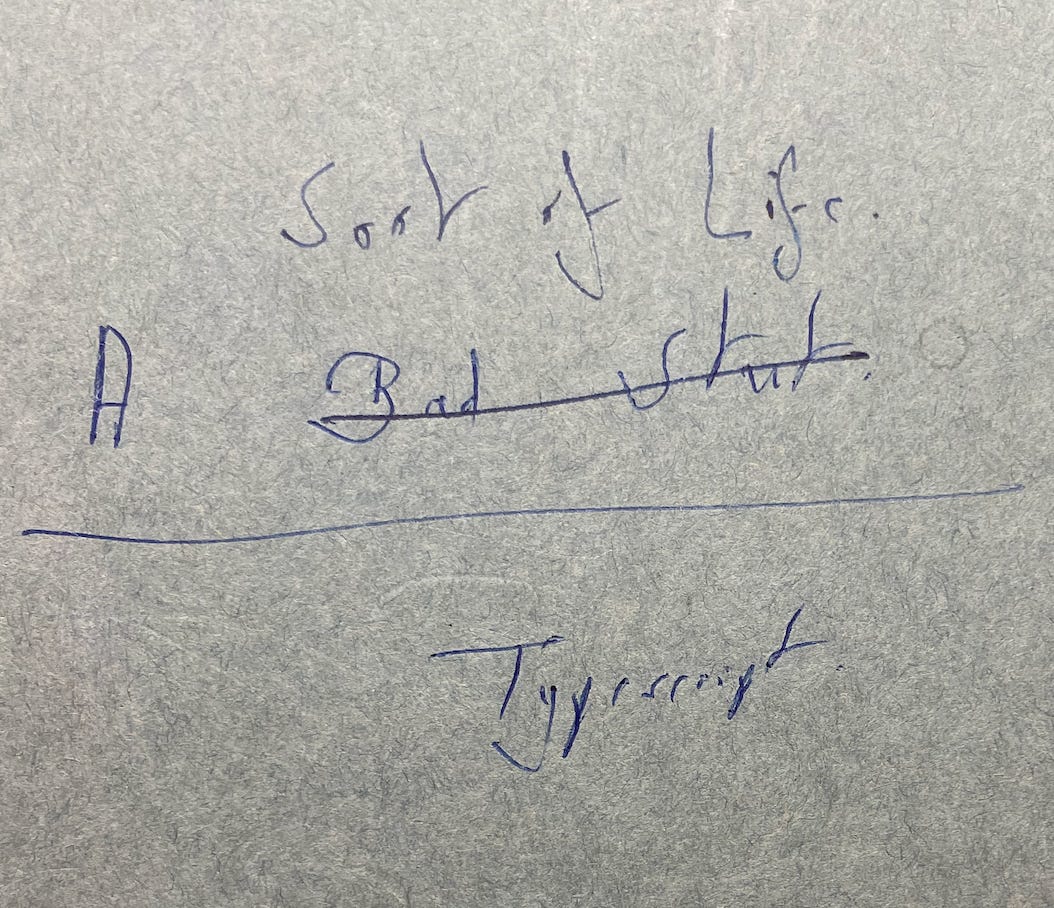
This Ms was the first thing I called up in Austin. I was looking to see if anything significant had been cut from the Nottingham chapter (there was a change after the first edition, affecting Cecil Roberts, and I’ll discuss that at the appropriate juncture). I particularly wanted to see the section that Greene later thought better of including, which is referred to in most of the biographies, about his visits to Soho.
The section appears directly before he describes his experience in Nottingham in the original A Sort of Life. Greene tells the reader that he first picked up a prostitute on Old Compton Street: ‘I had seized on the occasion, without any sexual desire at all, just to rid myself of my heavy virginity and ignorance. Naturally I was unable to do anything at all.’ He does not specify when this happened, possibly when he was an undergraduate (Richard Greene, in his biography, suggests that this happened in 1925). The woman told him not to worry. ‘But worry I did, until a second occasion, with a younger girl, round the corner from the Leicester Lounge, I found an unexpected release and happiness.’ He describes watching her comb her hair and hearing himself exclaim ‘how beautiful you are’. The girl reacts by ‘smiling, pleased by such a tribute rare enough after the act is over.’
He goes on to describe seeing the girl much later. She has never graduated from her Soho beat, ‘she was almost unrecognizable by then, she had stepped right into middle age, and no young man would ever again exclaim at the sight of her.’
Greene excuses his lack of sexual experience of the non-paid-for variety not by citing his love for Vivien, but like this: ‘Curiosity and lust were my pressing companions. Working as I did through the evenings I had few chances of finding adventures in my own class: cocktail parties and dinner parties were held at impossible hours for me, except on my one free night a week, and marriage seemed a long way off in an uncertain future.’ Here, Greene is living in Battersea, working evenings at The Times, earning £5 a week. in what he describes next, a ‘vice map’ he planned in his head. ‘Piccadilly was more expensive that Wardour Street, and as was to be expected Bond Street was more expensive than either.’
‘Catholicism’ he says, ‘had not given me a sense of sin’ (he crossed out the word ‘real’ before ‘sin’). He was breaking rules, that was all. He then goes on to describe the time he spent in brothels, particularly one ‘at the end of Savile Row where an arch and an alley led in the twenties to Conduit Street, next to the Alpine club’ (a sporty place his brother Raymond belonged to). ‘Unlike a French brothel no-one was pressed to order champagne so that one knew the exact limit of the cost.’ He calls himself Trench (after a pseudonym, Hilary Trench, that he used for verse while at Oxford). On his second visit the madame referred to him as ‘Captain Trench.’
There is quite a lot more to say about Greene and prostitutes. Some of it is in a novel I wrote many years ago, called The Pretender, which has Greene on the cover. The novel’s protagonist, Mark Trace, forges a short story by Greene shortly before the author’s death. He also investigates the authorship of a Soho prostitute memoir called To Beg I Am Ashamed by Sheila Cousins. I read this book because it was rumoured to have been at least partially ghost written by Greene. My reading suggests that Greene continued to use prostitutes (in Vietnam and Paris, for instance) until, at least, the beginning of his relationship with Yvone Cloetta, in the early 1960s. There’s a heartbreaking letter in the Ransom archive, in which Vivien explains her decision to sell his letters and explains when she found out about one particular sex worker, Annette, a Bond St prostitute who is discussed in all of the biographies.
Why did Greene choose to write about using prostitutes, especially when he emphasises how quickly he learnt ‘the dullness of the bought experience’? That is, I think, a more interesting question than why he chose to cut the chapter from the memoir. He wrote it, I think, because he is driven to be truthful and wants to give an unvarnished account of his adolescence. ‘Sex without responsibility is callous,’ he concludes, ‘but the young are callous, and it was not for me a squalid period of life. I remember it without regret.’
Greene, during this period of his life, was still an adolescent struggling with his sexual impulses and bipolar instincts. He found it easy to separate love and sex, as we see from his proposal of an ‘original’ monastic marriage to Vivienne. Graham and Vivien were to have, by all accounts, a very successful sex life in the early days of their marriage, but the ‘squalid period’ of Greene’s life did not end in the way he intimates. And perhaps this was another reason that Greene cut the chapter. It ends with a lie.
hanks for reading Greeneland. The next chapter will appear on Tuesday.
If you’re enjoying the novel and bonus posts, please tell your friends about it in whatever way suits you best. Word of mouth is by far the best recommendation.